Ben Groner III reviews
The Same Man
by Bobby Elliott
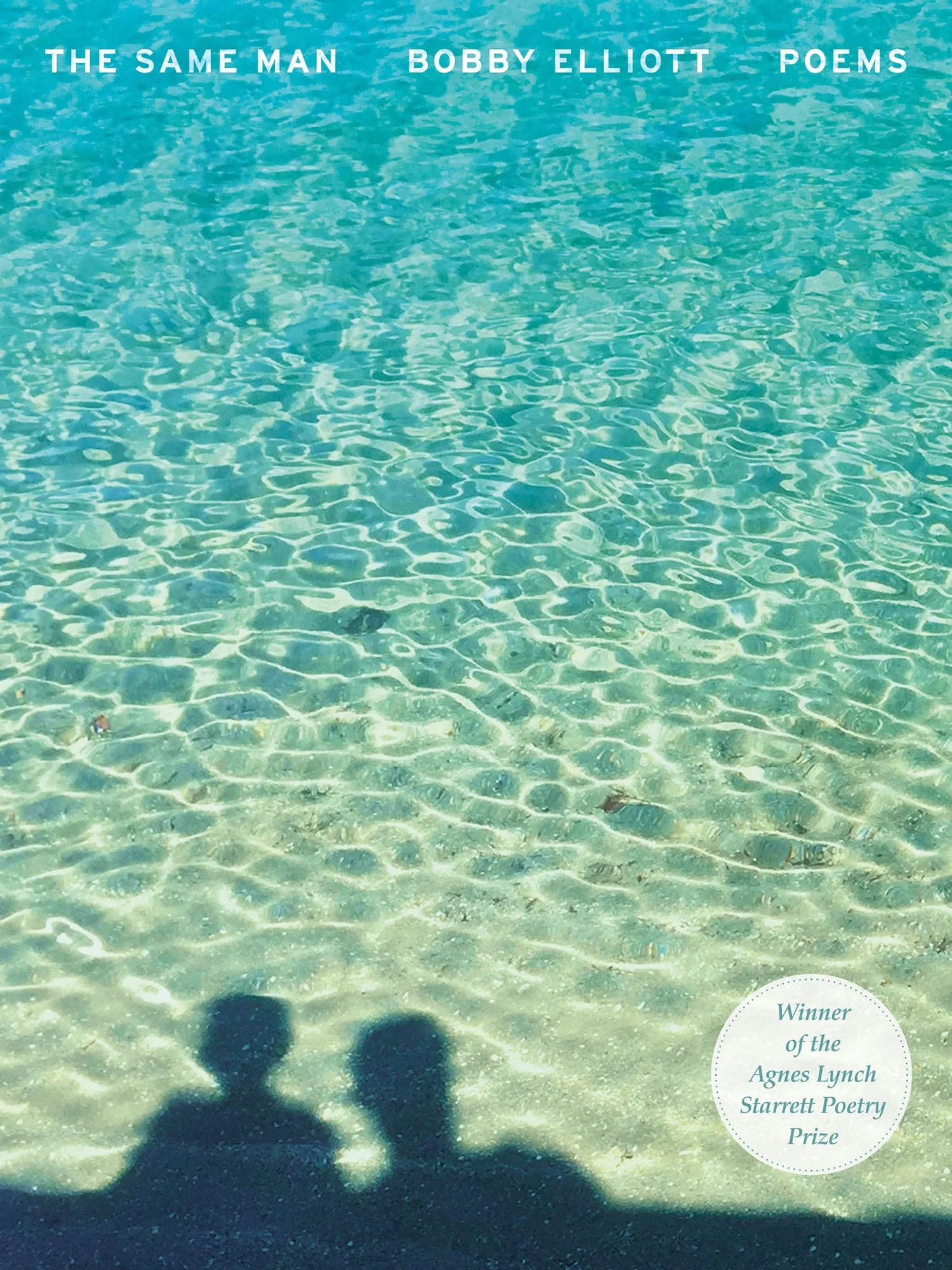
The Same Man
by Bobby Elliott
University of Pittsburgh Press
Sept. 2025
ISBN: 9780822967491
Paperback, 96 pages
$2o
In the quietly devastating opening poem of The Same Man, Elliott writes, “I’ve been thinking of how lost / you’d have to be / to believe you knew / everything there was to know / about yourself.” The poet is referring to his father, a bellicose, charming, haunted man who relentlessly “fished / for […] an excuse / to pack his shit / and go” (“Harmless”). The complexity of the strained relationship Elliott experienced with his father becomes apparent as the collection unfolds, and while this man looms large in these poems, another father is also vividly present on the page: the poet himself.
I would contend the beating heart of this debut is the astounded joy Elliott feels as a new father. After all, “When I Am Not Thinking of My Father,” a tight poem of tiny triplets, begins with his father holding a gun to his own head yet ends with the poet’s baby in a car seat looking like a “manger of light / in the mirror.” In a similar vein, addressing his newborn son in “Going Home” after he and his wife drive back from the hospital through wildfire smoke, he marvels that they are “brushing ash / like snow from your blanket.” In one of my favorite poems, “Lullaby,” their eyes are rain-heavy as they try to soothe their baby to sleep, this routine bedtime moment making Elliott think of “all the moons / I’ve missed, all the bald eagles / I should’ve stopped for” as they sing their song that won’t cease even when his son has grown into a teenager who is “slamming / [his] bedroom door or crashing [their] only car or calling [them] / mother fuckers, you beautiful, / beautiful boy.” I chuckled and teared up at the strong language because I could almost hear the brooding adolescent wrath, could sense the wellspring of parental love that will be impossible to exhaust.
The Same Man pendulums between this amazement at being a dad and the difficult relationship Elliott has with his own flawed parent. Are we destined to be the same as our fathers, even if they did the job poorly, even if we don’t know them at all? Do we inevitably become the ones who raised us? Are we the same essential beings we were before having children, or does that fulcrum change us in unnameable and sweeping ways? It’s worth taking a second to note Elliott’s father does not come off as some unredeemable monster—as a grandfather he’s “the patron saint / of fun,” and when the poet recalls performing CPR on him in the bathroom of a second-floor walk-up apartment, he also remembers all the times he attempted to convince his father to stay, to be in their family’s orbit one more day.
Further, like any poet worth his or her salt, Elliott skillfully finds new language to describe the life and memory and emotion he is committing to the page. In “Bills,” a compressed recollection of how money was tight growing up, he considers “the sun / untangling itself / like a shoelace / above the trees,” and while he knows the unmistakable sound of his parents fighting in “We Hold Each Other in the Kitchen,” he “[doesn’t] know / if the stars / populate the sky / like tumors / on a scan.” Or, when chronicling neighborhood scenes familiar from many occasions of pushing a stroller around the block in “What We See Together,” he mentions “both of us drawn like a bath / to the statue of St. Francis” and notices “the crows / on the power lines dripping / like an old shower head.” This collection’s realm is the domestic and the interior, traversing the wild inner terrains of the familial and the remembered.
Taken as a whole, these poems expose the wounds of his childhood and give voice to the wonder of raising a family of his own. Many of them inhabit quiet, everyday spaces—empty beaches, home offices, restaurants—the sorts of environments all of us move through. In this way, even the most unabashedly personal, the most searingly revealing lines embrace the reader like a friend, a father, a son, as if to say: I know you have your own journeys, your own scars. I know you too have love within you to give.
Ben Groner III is the author of the poetry collection Dust Storms May Exist (Madville Publishing), winner of the 2025 Storytrade Book Award for Poetry; the 2025 NYC Big Book Award for Poetry: Journeys, Memory, & the Self; and the 2024 American Fiction Award for Religious Poetry.
Bobby Elliott is the winner of the 2025 Agnes Lynch Starrett Poetry Prize from the University of Pittsburgh Press for his debut poetry collection, The Same Man. His writing has appeared in or is forthcoming from BOMB, The Cortland Review, ONLY POEMS, Poet Lore, Poetry Northwest, RHINO and elsewhere.