Dia Calhoun reviews
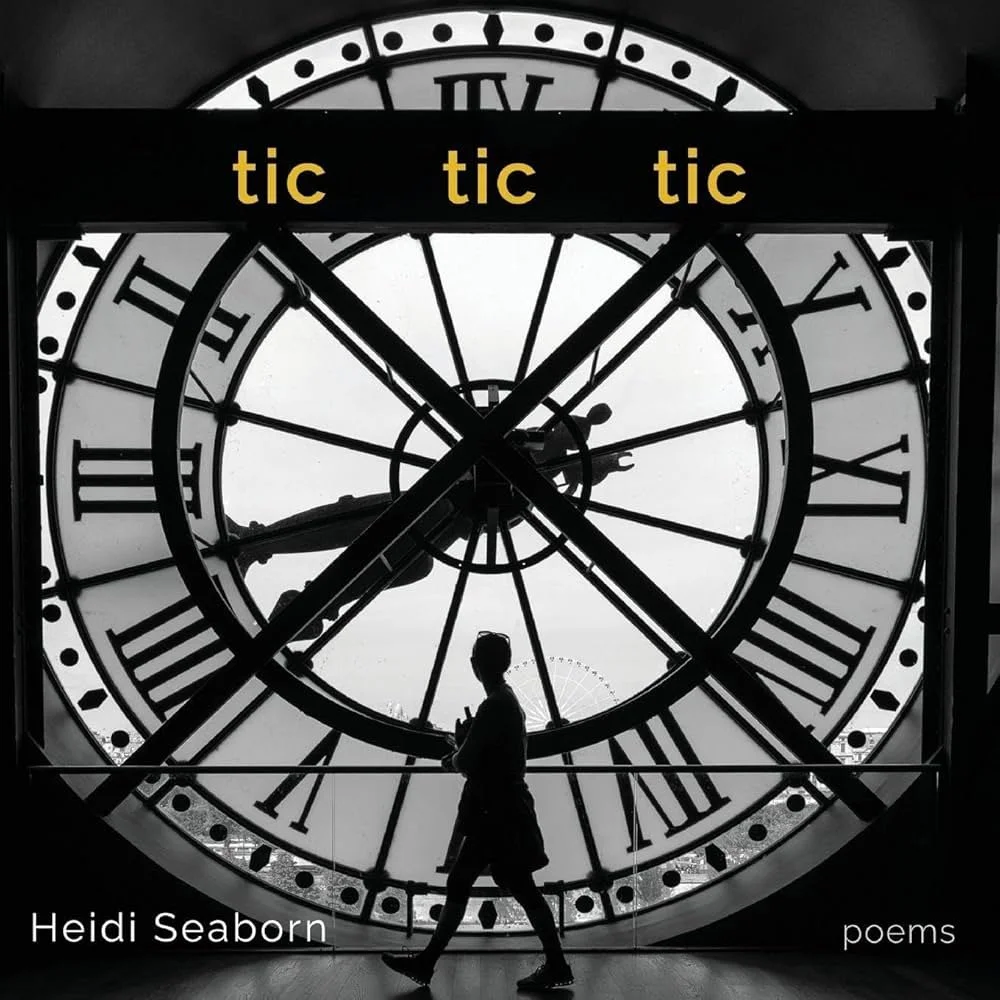
tic tic tic
by Heidi Seaborn
tic tic tic
by Heidi Seaborn
Cornerstone Press
Sept. 2025
ISBN: 978-1-968148-07-2
Paperback, 120 pages
$24.95
In tic tic tic Seaborn explores our relationship with time by taking fragments of history, music, literature, mythology, and personal life and weaving them into a whole, rich tapestry. She does this through both the actual poems and the book’s overall structure, poetic forms, and titles. The book’s division into four seasons reflects two of the poet’s passions: Vivaldi’s Four Seasons and T. S. Eliot’s The Four Quartets where he writes, “But to apprehend/The point of intersection of the timeless/With time is an occupation for the saint—” Like Eliot, Seaborn also engages with perennial questions around hope, faith, despair, and spiritual transcendence.
The beginning section, “Winter,” introduces two time-form structures that interweave throughout the book: continuums and time capsules. The poet will switch between time as a flow in the sweep of history and time as isolated moments—the timeless as warp and time as weft. “Winter” opens on covid’s brink:
CONTINUUM:
for the many dead
in this residence of woe—
And me, holding a family wedding photo.
This short poem announces how Seaborn will weave the personal into the historical into the mythical throughout the book. The first line, “for the many dead,” presages the death in “Winter.” The second line, “In this residence of woe,” is from “The Inferno” in the Divine Comedy. Seaborn will bring in threads of history by using quotations from Shakespeare to Pearl Jam. Her frequent use of the original Italian when quoting the Divine Comedy or Vivaldi’s Four Seasons’ sonnets adds to the textural sense of time and history being woven into a continuous tapestry. The third line, “And me, holding a family wedding photo,” is also the title of one of Seaborn’s personal time capsules, “Family Wedding Photo,” from the upcoming “Spring” section.
Music is another thread in the book’s tapestry. The first echo of the violin in The Four Seasons resounds in the poem “1 January 2020” with the line: “The lifted bow of another year hovers over the strings.” However, Seaborn’s “Winter” poems aren’t about one particular winter or even several, but rather about historical events that reflect the psychological destitution of winter—911, covid, J6, Roe’s overturning, October 7, 2023, and Trump’s 2024 return. Seaborn often gives our current time mythic overtones in the way she presents Trumpian history. In one of my favorite poems, “Winter 20-21” about J6, she includes this King Lear quote: “Darkness and devils! Saddle my horses, call my train together!” She immediately follows with her own line in a similar tone: “And then—the Bastille stormed by the king’s own men.” In the next-to-last poem in “Winter,” “Spring 2024,” she creates a marvelous mythic cocktail by weaving historical and literary quotes across time with her own life. (In stanza three the italicized Italian is the sign over hell in Dante’s “Inferno:” Abandon all hope, ye who enter here.)
The exiled king returns from the ruff—
up to his belly in muck, stench
perfumed with
Something’s always wrong. Again. Again. Again. (lyric from the album Dulcinea)
And aren’t we too sated for seconds?
I bring my knives to the butcher for sharpening—
I tenderize the lamb leg myself—
Easter’s early this year. We had thought Florida—
gawkers at the gates—Lasciate ogne speranza, voi ch’intrate.
I feel that sense of déja vu
as dictators shoulder around a game of Risk—
but there are too many to play—
and more on the way—stand by. Bereitstehen!
Continuing with quotes from Pearl Jam, Iron Maiden, and more, the poem builds to this line from “Game of Chess” in The Waste Land, “Do you remember—?” This segues to the time capsules in section two, “Spring,” with its idea of time as a container of memory. “Time Capsule,” has twenty-two short prose poems from 1958 to 2023, not always sequential. These compressed personal moments of the poet’s life sometimes intersect with world events. As a writer, I envy music’s ability to sound multiple notes at once in chords. Seaborn’s time capsules feel like chords.
The poems in “Summer” explore different ways to express perceptions of time. The poem title “42 days until the Election” is a countdown. “A Missive to My Father From the Now” looks back from the present moment. The stream of consciousness in “Split Second” records a moment in a form that actually takes us into timelessness. Although the ticking time bomb of climate change overlays the entire book, it flares with the wildfires in “Lookout,” the first poem in “Summer.” Again, the imagery and ideas echo back to “Inferno” and Eliot’s “Little Gidding” in The Four Quartets. Here are lines from “Skagit Valley,” part one of “Lookout:”
I am listening to a poet talk about refining fires—
the way Eliot thought about them—
purifying cauldron, the torching of our dross, all those sins—
It’s been the hottest summer on earth—
Seaborn’s ongoing conversation with Eliot’s repeated line in “Little Gidding:” “You are here to kneel,” is like variations on a musical theme—a part weaving a tapestry. Consider this from “Feverish,” the last section of “Lookout:” “And how every season—a wildfire. What good does it do to kneel—/before that destructive fire?” In “On the Continuum,” the first poem in” Summer,” is this variation: “I kneel in the wrath.” In “Summer’s last poem, “Perhaps This Is a Prayer,” comes the most surprising of Seaborn’s variations: “Me kneed by the burden / of body. A body now tilting/into a breeze gathering upward.” How wonderfully human this subtlety. There is no great solution, but we inch forward. “Autumn,” ends the book with its single poem “Take Five,” a phrase implying a momentary break in time. The last lines: “I’m vowing to stay alive with the man I love— / as the horn sheds its clothing on the floor.”
In its engagement with history, literature, music, and its connection to love and family, tic tic tic is profoundly relational. In the worsening fragmentation of our own era, this suggests a way forward. Consider Eliot’s line from The Waste Land: “I have shored these fragments against my ruin.” While Seaborn also uses fragments, she does something different. She weaves fragments into a whole that creates meaning, a tapestry that by the last page becomes more like a stained-glass window—all the different colored fragments pieced together, the light of love shining through.
Dia Calhoun has published poems and essays in The Nashville Review, The Writer’s Chronicle, EcoTheo Review, Grist Journal, and others and been nominated for the Pushcart Prize. She won the Mythopoeic Fantasy Award for Children’s Literature and is the author of seven young adult novels, including two verse novels. diacalhoun.com.
Heidi Seaborn is Executive Editor of The Adroit Journal and winner of The Missouri Review Editors Prize in Poetry. Heidi’s the author of three award-winning books/chapbooks of poetry: An Insomniac’s Slumber Party with Marilyn Monroe, Give a Girl Chaos, and Bite Marks. Recent work in AGNI, Blackbird, Copper Nickel, Financial Times, Image, Poetry Northwest, Rattle, Terrain,The Slowdown and elsewhere. Heidi holds degrees from Stanford and NYU.