
Willie James reviews
No Lace Fronts in Iowa City
by Meghan Malachi
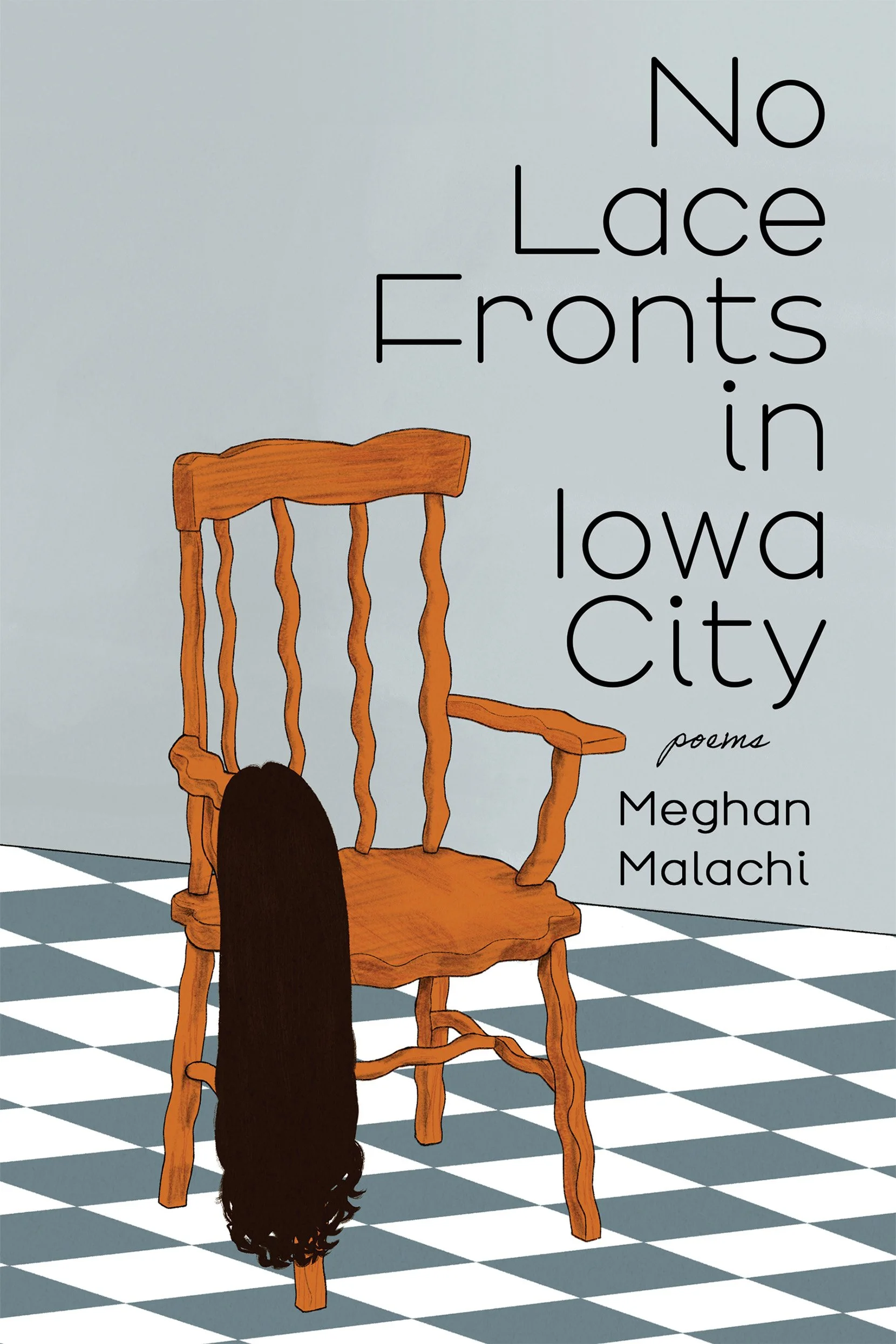
No Lace Fronts in Iowa City
by Meghan Malachi
Madville Publishing
June 2026
ISBN: 978-1-963695-69-4
Paperback, 102 pages
$19.95
I’ve never met Meghan Malachi, but it’s hard to read No Lace Fronts in Iowa City without feeling like I’ve gotten to know her. Or rather—without feeling like I’ve gotten to know this vivid speaker she has created. Malachi’s debut traces the journey of this speaker from the rootedness of her upbringing into the upheaval of a new city, through breakups and unstable mental health. Through odes, epistles, and recounted lessons the poems that follow look to weave a sense of ruptured identity back together.
So often poems in No Lace Fronts in Iowa City read like an invitation. That “I” that appears in nearly every poem feels constantly ready to drop whatever it’s doing the moment you, the reader, show up. Each poem is like a friend who’s available to call when you’re in need—or, better yet, who calls you because they know you’re having a hard time.
From the very first poem, Malachi introduces this welcome, beginning the collection with a love letter to an unnamed friend:
“[Girl, I] love you/ to the dominican republic/ and back. from the grease/ your mother palms into/ the only mangú I’ll ever eat / to the folding chair you save/ for me at the back of church.”
I love that with this unnamed “you”, I get to feel like I am that friend, with a seat pulled up right beside the speaker, sharing a plate of mangú with her.
The collection goes on to recount the lessons of her grandmother, the various names and styles of her collection of wigs, her feelings on Nelly Furtado, the language of mathematics, her grandparent’s declining health, as well as the speaker’s struggle with their sense of self while at school in Iowa City.
In the collection’s titular poem, Malachi writes, “i bet against/ myself/ in this city/ how many times/ i chose myself/ despite myself.” And then it goes on, in this city where “mathematicians quarrel like lawmakers” and where each smile is “a breaking/ of burnt/ bread”, Malachi announces, “I’ve splayed myself/ flat/ rugged/ ridiculous and/ wide/ as tenderloin/ and i/ prevailed.”
As the collection navigates these wide midwestern streets, we find alongside these struggles touchstones that reaffirm a sense of identity. We encounter family and friends; purses and plantains. The book is filled with these lodestars, guiding us through the ruptured landscape: we return to math class, return to Sylvia Plath, return to hair and hairstyles and an ever-twisting road home.
This collection is threaded together with hair: wet hair, natural hair, horse hair, choregraphed hair. There is hair “pouring down my/ back like rain” and there are “oiled grid[s] of banded hair,/ held [in] sections like stalks sprouting.” This book braids itself through its repetition of images and phrases and gathers inside them family and loved ones. This coming together is what offers relief and what gives this collection its magic.
By its end—after panic attacks, Prozac, and a thousand flicks of the light switch of OCD—I am left with a sense that roots have been put down. Not into a particular landscape or a single thing, but into the pages of this book and into the lines that break into that deeper soil of identity. In these poems, a sense of confidence grows, as we watch the speaker “tuck/ this ear-length hair into that fishtail/ braid/ I always wanted.”
No Lace Fronts in Iowa City is an excellent debut and a wonderful introduction to Meghan Malachi, a poet I’m grateful now to be acquainted with.
Meghan Malachi is a poet from The Bronx. Her debut collection No Lace Fronts in Iowa City was selected as runner-up to the 2024 Arthur Smith Poetry Prize and is forthcoming in 2026. In 2026, she was named one of 35 Writers to Watch by the Guild Literary Complex. She lives in Chicago, Illinois.
Willie James is a poetry editor at Pacifica Literary Review. He has received scholarships from Bread Loaf Writers’ Conference and the WxW Tomales Bay Workshop. A runner-up for Rhino’s 2017 Founder’s Prize, his work appears in Los Angeles Review, Willow Springs, among other journals.